If there's one service that separates "pretty good" lawns from genuinely healthy lawns in Missouri, it's aeration. And yet it's also one of the services people understand the least.
We can't tell you how many times someone's asked us, "So you're just poking holes in my lawn? That seems… weird." And fair point. It does sound counterintuitive to deliberately damage grass to help it.
But here's the thing: after 30+ years of caring for lawns in Rolla, St. James, St. Robert, Waynesville, and Valley Park, we can tell you with certainty that aeration changes everything. A lawn that's been aerated regularly has deeper roots, healthier soil, better water infiltration, and simply looks better. It's not weird—it's essential.
This guide explains what aeration actually is, why Missouri lawns specifically need it, when to do it, and how to decide between DIY and professional service.
What Is Aeration? (Simple Explanation)
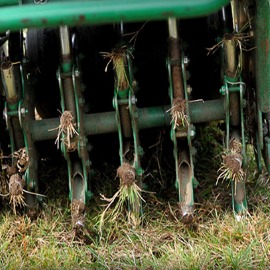
Aeration is the process of creating small holes in your lawn and removing small cores of soil. That's it, basically. But the effects go way deeper than you'd think.
How It Works
A machine called a core aerator (not a spike aerator—we'll explain the difference) removes plugs of soil about half an inch in diameter and 2-3 inches deep. These plugs are typically pulled to the surface and left there. Your lawn ends up looking like it has small cylindrical cores scattered across it—which it does.
The number of holes varies, but a typical aeration might create 20,000-40,000 holes per 5,000 square feet. That sounds aggressive, but remember: you're creating maybe one hole per square inch. Grass fills in quickly.
What Happens Next
Here's where it gets interesting. Those holes accomplish several things simultaneously:
1. They relieve compaction. Soil compaction is the enemy of healthy lawns. Heavy use (foot traffic, equipment), repeated mowing, and especially clay-heavy Missouri soil all contribute. Aeration breaks up that compaction.
2. They improve water infiltration. Water moves through those holes instead of running across the surface.
3. They enhance oxygen movement. Roots need oxygen. Compacted soil restricts it. Aeration fixes that.
4. They improve nutrient availability. When soil is compacted, nutrients stay locked up. Aeration makes them accessible.
5. They create seed-to-soil contact for overseeding. Those holes are perfect for new seed. Grass planted in aeration holes has dramatically better germination.
It's not magic. It's just basic soil physics. And Missouri's clay-heavy soil makes it extra important.
Why Missouri Lawns Specifically Need Aeration
Missouri sits in an interesting region. Our soil tends to be heavier—more clay, less sand. This is great for water retention (good in dry periods) but terrible for drainage and root development (bad in wet periods and for long-term soil health).
Clay Soil Challenges
Clay soil compacts easily. It doesn't drain well. It's dense. Your cool-season grasses (Kentucky bluegrass, tall fescue, perennial ryegrass) can grow in clay, but they prefer looser, more open soil where roots can penetrate deeply.
Without aeration, those roots stay shallow. Shallow roots mean less drought tolerance, more dependence on frequent watering, and less ability to access deep soil nutrients.
Residential Traffic and Compaction
If you live in most residential neighborhoods, your lawn gets walked on. Kids play on it, you mow it, service trucks drive across it occasionally. Each of these compresses soil slightly. Over years, that adds up to serious compaction.
In Missouri's clay-heavy soil, compaction becomes really obvious—water starts pooling, grass gets thin, and the lawn feels hard underfoot. Aeration directly addresses this.
Climate Stress
Missouri has temperature and moisture extremes. Winters can be harsh, summers can be hot and dry, and spring can be unpredictably wet or dry. Deep, strong roots—the kind you get from aeration—help grass handle all of this better.
Bottom line: Most Missouri lawns benefit from aeration every 1-2 years. Some lawns need it every year. Few lawns can skip it entirely.
When to Aerate: Spring vs. Fall
This is where people get confused. You've probably heard conflicting advice. Let's clear it up.
Spring Aeration (March-May for Missouri)
Best timing: Early-to-mid April (after soil has warmed to 50°F+ and before summer stress hits)
Pros:
- Soil is moist and easier to aerate
- Grass is actively growing and recovers quickly
- Perfect timing for spring overseeding
- If you aerate + overseed + fertilize in April, results are dramatic
- Addresses winter soil damage
Cons:
- Weather-dependent (too wet and you can't get equipment in; too dry and it's hard work)
- Only one growth period to recover before summer heat
- If summer is hot and dry, stressed grass is more vulnerable
Fall Aeration (August-October for Missouri)
Best timing: Mid-to-late September (when cool-season grasses start fall growth surge)
Pros:
- Ideal timing for grass recovery—fall is peak growth season
- Perfect for fall overseeding (fall seed + fall aeration = excellent results)
- Builds root strength for winter
- More consistent weather (fewer scheduling issues)
- Two growth periods to recover before next summer (fall + spring)
Cons:
- Slightly later into the year
- Fall schedule fills up quickly for professional services
Which Should You Choose?
Do spring aeration if:
- You need to address winter damage or heavy compaction
- You're overseeding to fill spring bare spots
- You haven't aerated in 2+ years
- You want to get it done early in the year
Do fall aeration if:
- You want the best recovery window (fall growth is strong)
- You're planning fall overseeding
- Your lawn is generally healthy (not urgently compacted)
- You want better winter root development
The ideal answer: Both. Many professional lawn care programs aerate in spring AND fall. If your lawn is heavily used, compacted, or you want premium results, two aerations per year is justified.
Minimum: Most lawns need at least one aeration annually. If you're only doing one, fall (September) is slightly better than spring because recovery time is stronger.
Signs Your Lawn Needs Aeration
Not sure if your lawn needs aeration? Here are the indicators:
Clear Signs of Compaction
- Water pools in certain areas instead of soaking in
- Grass is thin even where you don't have disease or pest problems
- Soil feels hard when you walk on it
- Roots are very shallow (you can pull grass up easily)
- Moss is growing in shaded areas (often indicates poor drainage)
Recent Heavy Stress
- New construction or landscaping (equipment compacted soil)
- Heavy foot traffic (kids play area, main pathway)
- Thatch buildup (more than half an inch)
- Poor drainage issues throughout the lawn
- Winter damage that's extensive
Performance Issues
- Lawn hasn't improved despite fertilization and watering
- Weeds invade easily (compacted soil is vulnerable)
- Drought stress even with regular watering
- Uneven growth across the property
If you're seeing 2-3 of these, aeration should be in your near-term plan.
Aeration vs. Dethatching vs. Overseeding (What's the Difference?)
These terms get thrown around interchangeably, but they're different services that often work together.
Aeration
What it does: Removes compaction by creating holes in soil. Pulls small cores.
Why: Improves soil health, water infiltration, root depth.
Best for: Every lawn, at least annually.
Dethatching (Power Raking)
What it does: Uses aggressive raking to remove thatch (dead grass and organic matter) from the top layer of soil.
Why: Excessive thatch (more than 1 inch) blocks water and nutrients from reaching soil.
Best for: Lawns with 1+ inch of thatch buildup.
Note: Spring (late March-April) is ideal for power raking.
Overseeding
What it does: Spreads seed over existing lawn (no removal).
Why: Fills in thin areas, improves grass density, replaces winter-damaged areas.
Best for: Combined with aeration or overseeding alone if damage is light.
Note: Works best in spring (April) or fall (September-October) and requires consistent moisture for 2-3 weeks.
The Powerful Combination
Spring: Power rake + Aerate + Overseed + Fertilize
If your lawn is rough, this combination in April is transformative. It addresses thatch, compaction, thin areas, and nutrient needs all at once. Recovery is strong through spring and summer.
Fall: Aerate + Overseed + Fertilize
In September-October, this combo builds strong fall growth and sets you up perfectly for winter and the next growing season.
DIY vs. Professional Aeration: The Real Costs
This is an important decision. Let's talk about what's actually involved.
DIY Aeration
Equipment: Core aerator rental, typically $50-75 per day from equipment rental companies.
Your cost:
- Rental: $50-75
- Gas: $10-15
- Supplies (none really): $0
- Total: $60-90 for a typical residential lawn
Labor & Time:
- Setup and travel to rental place: 1 hour
- Aeration: 2-4 hours (depending on lawn size and soil condition)
- Cleanup (spreading plugs, etc.): 1 hour
- Total: 4-6 hours of your time
Results:
- Variable (depends on your technique, equipment condition, physical capability)
- Rental machines are often older and less efficient than professional-grade
- Easy to miss areas or over-apply in others
- Risk of injury if you're not experienced with heavy equipment
Professional Aeration
Cost: Typically $250-500 for residential property (varies by size and complexity)
Why the difference:
- Professional-grade equipment (better penetration, more consistent)
- Expertise (operator knows how to handle different soil conditions)
- Efficiency (we aerate 10-15 properties per week; you do it once every 2 years)
- Timeliness (we're there when conditions are perfect; you work around your schedule)
- Guaranteed results
- Often combined with overseeding, fertilization (package pricing available)
Results:
- Consistent, professional-grade coverage
- Better hole density and depth
- Proper timing (we know when conditions are ideal)
- No physical strain on you
- Warranty on work
The Decision
DIY makes sense if:
- You have a small lawn (under 3,000 sq ft)
- You have the physical capability and equipment access
- You're not in a rush for perfect timing
- You're mechanically inclined and comfortable with equipment
Professional service makes sense if:
- You want consistency and guaranteed results
- You have a larger lawn or complex property
- Timing is important (you want it done right when conditions are ideal)
- You want to combine it with other services (overseed, fertilize)
- Your time is valuable
Our take: For most Missouri homeowners, professional spring aeration combined with DIY maintenance makes sense. You get expert work when it matters most, and you maintain it yourself.
Post-Aeration Care
If you aerate, you need to handle the aftermath properly.
Immediately After
Leave the plugs: Those small cores you see scattered across the lawn? Leave them. They'll break down naturally in 1-2 weeks and work back into the soil, feeding it organic matter.
Don't rake or sweep them: You're trying to move that organic matter back into the soil, not remove it.
Overseed if planned: Aeration holes are the perfect home for grass seed. If overseeding, do it immediately after aeration.
First 2 Weeks
Water consistently: If you overseeded, new seed needs moisture. If you didn't overseed, regular watering still helps the soil recover.
Avoid heavy traffic: Let grass recover. Don't schedule kids' soccer games or parties for a week.
Don't fertilize yet: Wait a week before applying fertilizer (unless you applied it right before aeration). Let the aeration process do its work first.
Following Week(s)
Monitor moisture: Overseeded areas especially need 2-3 weeks of consistent moisture (1-2 inches per week total, from rain or irrigation).
Mow when ready: Once grass reaches 3.5+ inches (usually 1-2 weeks after aeration), mow at normal height. Mowing actually helps recovery by evening growth.
Apply fertilizer: If you didn't apply it right after aeration, fertilize 1-2 weeks post-aeration.
Avoid harsh chemicals: Don't apply weed killers or other harsh treatments for 2-3 weeks. Let grass focus on recovery.
Do You Really Need Professional Help?
Let's be honest about this. After 30 years, we know when people genuinely need professional help and when DIY is fine.
You need professional aeration if:
- Your lawn hasn't been aerated in 2+ years
- Compaction is severe (water won't infiltrate, soil is hard)
- You want the absolute best results
- You're overseeding significantly
- You want it timed perfectly with other lawn care (fertilization, weed control)
You can DIY if:
- Your lawn is less than 3,000 sq ft
- Compaction is mild
- You're comfortable with equipment
- You have the time
- You're not overseeding at the same time
You could split the difference:
- Professional aeration in spring, DIY maintenance through summer
- Or professional in fall (when it's most important), maintain yourself
- Or let us aerate + overseed + fertilize in one package, and you handle summer
Aeration Frequency: How Often?
Here's the practical question: How often do you need it?
Annually (every year):
- Lawns with heavy traffic
- Heavily compacted soil
- Properties with new or poor drainage
- Lawns being renovated
- Anyone aiming for premium appearance
Every 2 years:
- Most healthy residential lawns
- Lawns with moderate traffic
- Well-established lawns without major problems
Every 3+ years:
- Unusually healthy lawns (rare)
- New homes with good initial soil prep
- Lightly-used properties
In Missouri's climate, we recommend annual aeration for best results. If budget is tight, every 2 years is acceptable for average lawns.
Ready to Transform Your Lawn Through Aeration?
Aeration is one of those services that seems simple but delivers dramatic results. A compacted Missouri lawn transformed through aeration and overseeding looks and performs completely differently. Better color, deeper roots, stronger stress tolerance, easier to maintain.
If you're looking at your lawn and thinking it's time to do something more serious, aeration is usually the answer.
Maedgen's Lawn Care has been aerating Missouri lawns for over 30 years. We know Missouri soil. We have professional-grade equipment. We combine aeration with overseeding and fertilization for maximum results. And we're available across Rolla, St. James, St. Robert, Waynesville, and Valley Park.
Call us at (573) 647-2823 or request your free estimate today. Let's talk about whether aeration is the right next step for your lawn.
Related Posts:
- Spring Lawn Care Checklist: What Your Missouri Lawn Needs in March & April
- Lawn Renovation Services
- Seasonal Cleanups & Site Preparation
- Schedule Your Aeration Service
Not sure where to start?
We’ll walk your property and recommend exactly what your lawn needs — no pressure, no obligation.
We respond within 1 business day.